
When people search for wrongful death vs. negligence in Arizona, they’re usually trying to answer one important question: What kind of claim does my family actually have?
You lost someone, and somewhere along the way you started hearing two different phrases attached to what happened: wrongful death and negligence.
Maybe a friend used one, an insurance adjuster used the other, and now you’re wondering whether they mean the same thing or whether you’re supposed to be pursuing something different than you first thought.
You’re not overthinking it.
The truth is that wrongful death and negligence are closely connected, but they are not the same thing.
Understanding the difference can help you make sense of your legal rights and what options may be available after the loss of someone you love.
Wrongful Death vs. Negligence in Arizona: Understanding the Difference
Negligence Is the Legal Wrong
Negligence is the legal concept that forms the foundation of many personal injury and wrongful death claims. It happens when a person or organization fails to use reasonable care, causing harm to someone else.
Understanding the difference between wrongful death and negligence in Arizona starts with knowing that negligence describes the conduct that caused the harm, while wrongful death describes the legal claim that may arise after a fatal injury.
Negligence can occur in many situations, including:
- Car and truck accidents
- Medical malpractice
- Nursing home abuse or neglect
- Construction site accidents
- Dangerous property conditions
- Defective products
To prove negligence under Arizona law, four elements generally must be established:
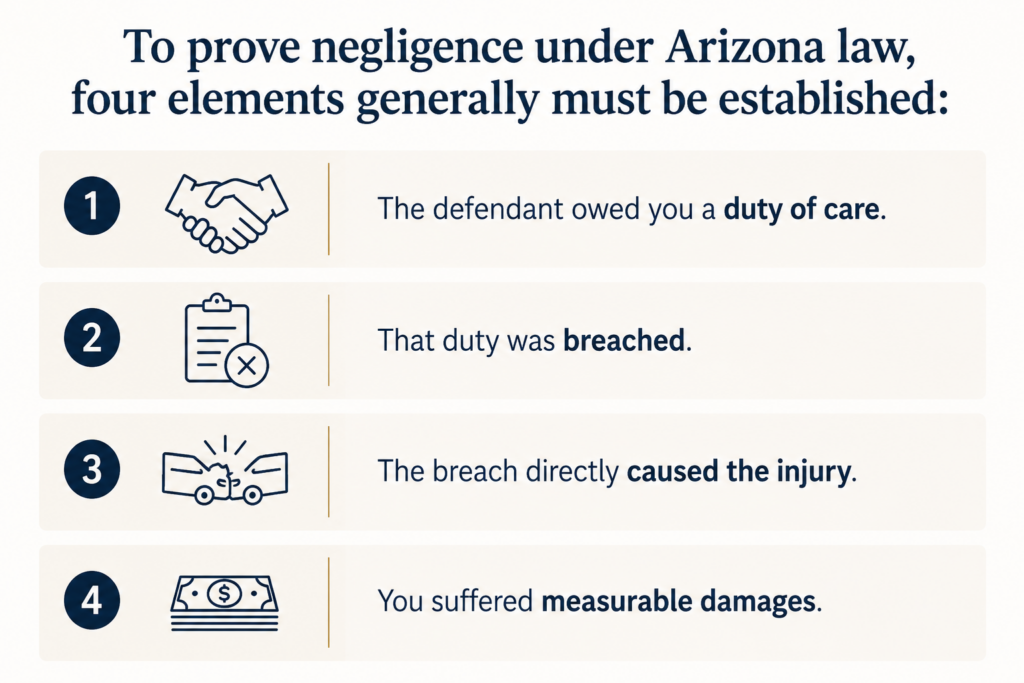
Without negligence or another legally wrongful act, there is usually no basis for a personal injury or wrongful death claim.
Arizona also follows a pure comparative fault system. Under A.R.S. § 12-2506, each party is responsible only for their percentage of fault. If the injured person shares some responsibility for what happened, that percentage may reduce the amount they or their family can recover, but it does not automatically prevent recovery altogether. This rule applies to both personal injury and wrongful death claims.
Wrongful Death Is the Legal Claim
Under A.R.S. § 12-611, Arizona law allows a wrongful death claim when a person’s death is caused by another party’s wrongful act, neglect, or default, and the deceased could have brought a personal injury claim had they survived.
Wrongful death does not create a new definition of wrongdoing. The court must still determine that the defendant acted negligently or engaged in another wrongful act. The wrongful death statute simply allows certain surviving family members to pursue a claim after the injured person is no longer able to do so.
This distinction is what separates a wrongful death vs. negligence Arizona claim. One explains why the defendant may be legally responsible, while the other determines who has the legal right to pursue compensation after a loved one’s death.
In simple definition:
- Negligence is the conduct that caused the harm.
- Wrongful death is the legal action that follows when that conduct results in a person’s death.
Arizona’s wrongful death laws allow eligible surviving family members to seek compensation for the losses they experience because of their loved one’s death.
A Simple Example of Wrongful Death Claim with Negligence
Imagine a distracted driver runs a red light and crashes into another vehicle.
If the victim survives with serious injuries, they may bring a personal injury claim based on the driver’s negligence.
If the victim later dies from those injuries, eligible family members may instead pursue a wrongful death claim based on that same negligent conduct.
The negligence has not changed. Only the type of legal claim changes because the outcome became fatal.
Who Can File Each Type of Claim?
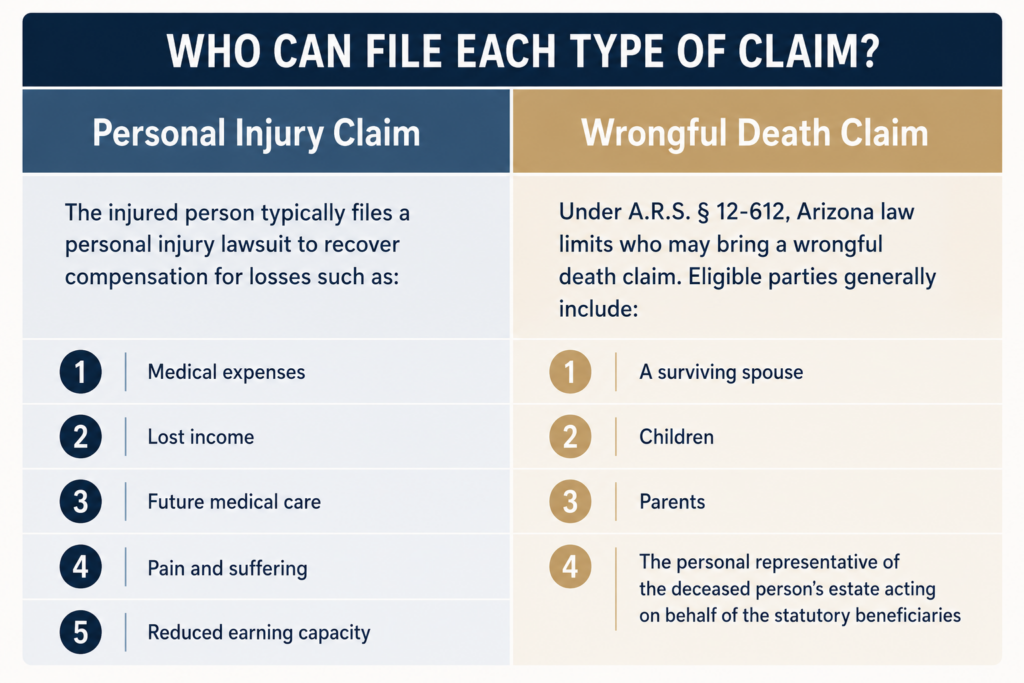
Who may recover depends on the family’s circumstances and Arizona’s wrongful death statutes.
Although multiple family members may qualify as beneficiaries, Arizona law generally requires one plaintiff to bring the wrongful death action on behalf of everyone entitled to recover. This differs from a personal injury claim, where the injured person controls their own lawsuit.
How Compensation Differs in Wrongful Death vs Negligence
Although both claims often arise from the same negligent act, they compensate different losses.
A personal injury claim focuses on what the injured person has lost, including:
- Medical bills
- Rehabilitation costs
- Lost wages
- Pain and emotional suffering
A wrongful death claim focuses on the losses experienced by surviving family members.
Under A.R.S. § 12-613, an Arizona jury may award damages it considers fair and just based on the family’s losses. Depending on the circumstances, compensation may include:
- Funeral and burial expenses
- Loss of financial support
- Loss of companionship, care, guidance, and consortium
- Emotional suffering experienced by surviving beneficiaries
Unlike a personal injury claim, which compensates the injured person directly, a wrongful death claim compensates surviving family members for the losses they suffer because of the death.
In some cases, a separate survival action under A.R.S. § 14-3110 may also preserve claims the deceased person could have brought had they lived. This can include medical expenses incurred before death and other damages recoverable by the estate. A survival action is legally distinct from a wrongful death claim, and in many cases the two actions proceed together.
Can Negligence Exist Without Wrongful Death?
Yes.
Most negligence claims do not involve a fatality. Every day, people file personal injury claims after suffering injuries ranging from broken bones to life-changing disabilities.
Wrongful death claims only arise when negligence or another legally wrongful act results in someone’s death.
Can Wrongful Death Exist Without Negligence?
Sometimes.
Although negligence is the most common basis for a wrongful death lawsuit, Arizona law also allows wrongful death claims arising from other wrongful conduct, including:
- Intentional acts
- Certain criminal acts
- Reckless conduct
- Other unlawful actions that cause death
The central question is whether another person’s wrongful conduct caused the death.
Why the Difference Matters
If you’re comparing wrongful death vs. negligence in Arizona, understanding these legal differences can affect every part of your case, from who files the lawsuit to what damages may be available and which deadlines apply.
Understanding whether your case involves a personal injury claim, a wrongful death claim, or both affects:
- Who has the legal right to file
- What evidence must be gathered
- What damages may be available
- Which legal deadlines apply
Arizona generally gives families two years to file both negligence-based personal injury claims and wrongful death claims under A.R.S. § 12-542. The difference is when that deadline begins.
For a personal injury claim, the clock usually starts on the date of the injury.
For a wrongful death claim, it generally starts on the date of death. If someone survives for weeks or months after the original incident before passing away, the wrongful death deadline begins later than the personal injury deadline.
There are important exceptions. If the claim involves a government entity, such as a city-owned vehicle or an unsafe public roadway, Arizona law generally requires a Notice of Claim to be filed within 180 days under A.R.S. § 12-821.01. Missing that deadline can prevent a claim from moving forward, even when negligence is clear.
Because the filing deadlines depend on the type of claim, families may have both a wrongful death claim and a survival action arising from the same incident, each with different legal considerations. Understanding which claims apply as early as possible can help preserve important legal rights.
Why the Difference Matters for Your Family
The distinction between wrongful death and negligence in Arizona is more than legal terminology. It determines who has the right to bring a lawsuit, what damages may be recovered, whether a survival action should also be filed, and how much time you have to act.
Knowing which category your situation falls into can help your family make informed decisions during an already difficult time.
Compassionate Guidance After a Preventable Loss
No lawsuit can bring back someone you love.
But pursuing a claim can help provide financial stability, hold the responsible party accountable, and give your family answers during an incredibly difficult time.
At Miller Kory Rowe, families receive personal attention from experienced Arizona trial attorneys who handle catastrophic injury and wrongful death cases. Whether the loss resulted from medical malpractice, a trucking collision, nursing home neglect, a construction accident, or another act of negligence, the firm’s attorneys work to build strong cases with compassion, skill, and decades of courtroom experience.
If you’re still unsure about the difference between wrongful death and negligence in Arizona, speaking with an experienced Arizona wrongful death attorney can help you understand which claims may apply, who has the legal right to file them, and the deadlines that could affect your family’s case.