
Whether the caregiver is a nursing home nurse, an in-home aide, or a family member managing the pill box, a sudden, unexplained change in alertness, mood, or physical function is one of the most common signs of a medication error that nobody caught in time.
Being given the wrong medication is not a rare occurrence: adverse drug events send an estimated 1.5 million people to the emergency room every year, and older adults carry a disproportionate share of that risk.
How Medication Errors Happen With Any Caregiver
Errors tend to cluster around a few points in a person’s care, no matter the setting:
Transitions between caregivers or facilities.
When someone moves from a hospital to a nursing home, from one caregiver’s shift to another, or simply comes home from an appointment with a new prescription, the medication list has to be reconciled by hand in many cases.
A missed drug, a wrong dosage carried over from an old chart, or a medication that was supposed to be discontinued but wasn’t can slip through during that handoff.
Look-alike, sound-alike drugs.
Some medications have names or packaging similar enough to cause mix-ups, especially when a caregiver is rushed, tired, or unfamiliar with a new prescription.
Understaffing or an overwhelmed caregiver.
Whether it’s one nurse responsible for dozens of residents during a facility’s medication pass, or a single family member juggling caregiving with a full-time job, the checks that normally catch an error, like verifying the right person, right drug, right dose, and right time, get skipped when a caregiver is stretched too thin.
Lack of training.
Not every caregiver, paid or unpaid, has been trained on how to administer medication safely, what interactions to watch for, or when a side effect needs medical attention rather than a wait-and-see approach.
Duplicate prescriptions and unreported over-the-counter drugs.
A person can end up on two versions of the same drug under different brand names, prescribed by different doctors who never compared notes.
Over-the-counter medicines and supplements add another layer of risk, since a caregiver who doesn’t ask about them may miss a dangerous combination, like a supplement that thins the blood alongside a prescribed blood thinner.
Chemical restraint.
In some cases, a caregiver administers a sedative or antipsychotic not because a medical condition calls for it, but because it makes the person easier to manage.
This isn’t a documentation slip. It’s a decision, and Arizona law treats it as abuse regardless of whether it happens in a facility or a private home.
Physical Signs Your Loved One May Have Received the Wrong Medication
A medication error doesn’t always announce itself. Sometimes it looks like someone simply having a bad day. Watch for changes that come on suddenly rather than gradually, especially if the caregiver can’t explain what caused them.
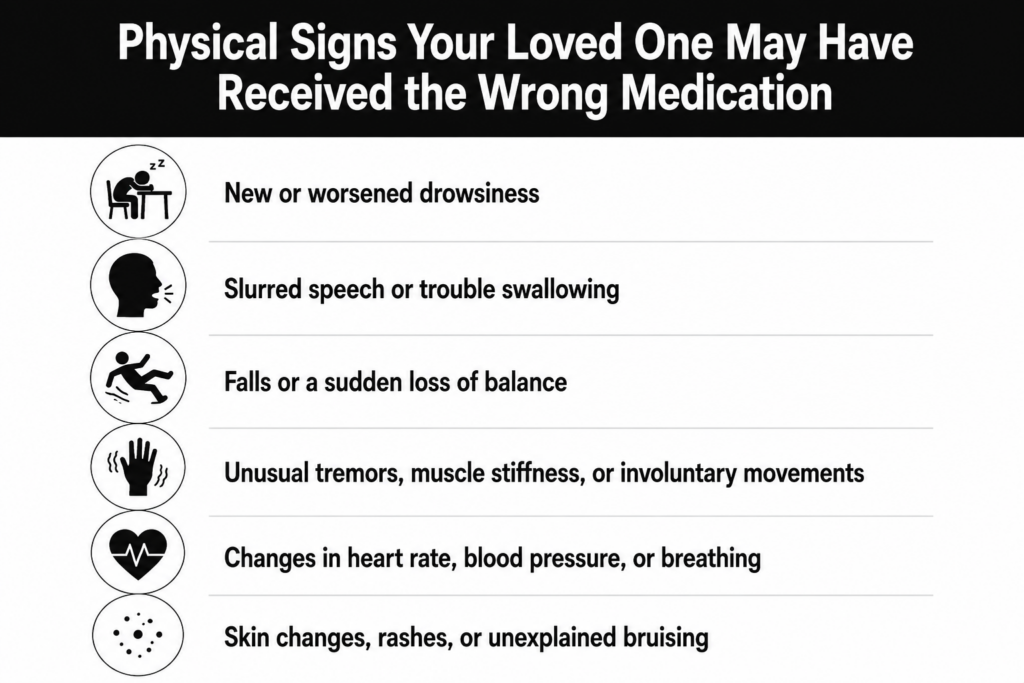
New or worsened drowsiness. Someone who was alert and talkative is suddenly hard to wake up, nodding off mid-conversation, or sleeping through meals.
Slurred speech or trouble swallowing. These can signal oversedation, a drug interaction, or a stroke, and any of those needs urgent medical attention.
Falls or a sudden loss of balance. Many drugs affect blood pressure, coordination, or alertness. Someone who has never had a fall history and suddenly falls, or falls repeatedly in a short window, may be reacting to a medication error.
Unusual tremors, muscle stiffness, or involuntary movements. These can point to an overdose or a reaction between two drugs that shouldn’t have been combined.
Changes in heart rate, blood pressure, or breathing. Vital sign swings that can’t be tied to an illness are a red flag, particularly with heart medications, blood thinners, or insulin.
Skin changes, rashes, or unexplained bruising. Some medication reactions show up on the skin first. Bruising can also indicate a blood thinner dose was too high.
Behavioral and Cognitive Signs of a Medication Error
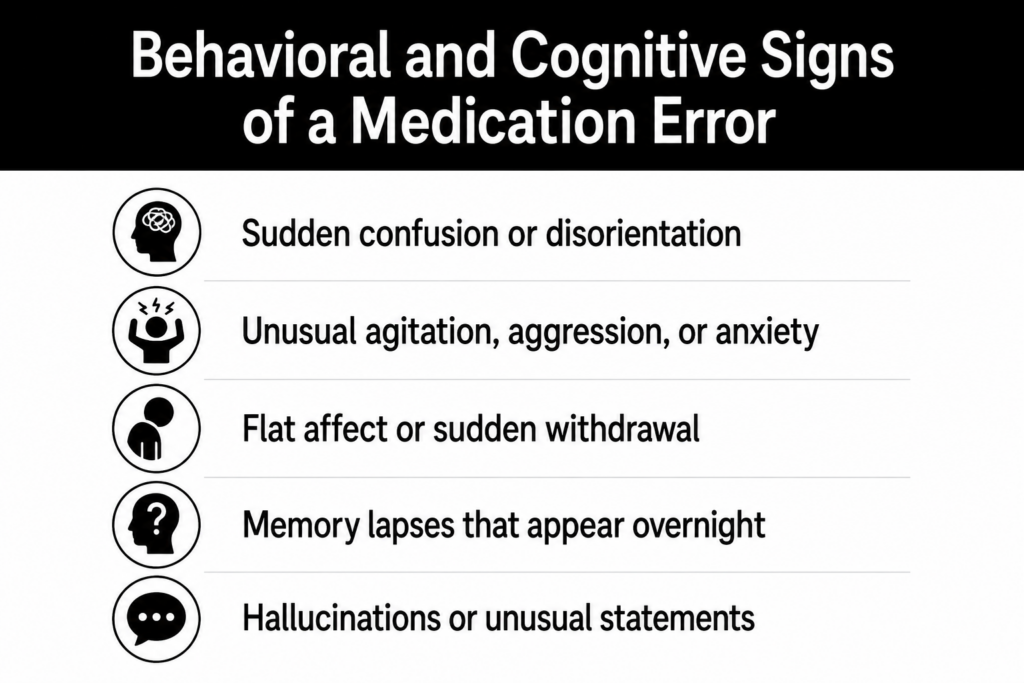
Cognitive and mood changes are easy for a busy caregiver, paid or unpaid, to write off as “just part of getting older” or “just part of the dementia.” That framing can hide a treatable problem.
Sudden confusion or disorientation, especially in someone who was previously oriented to time and place. New confusion in an older adult should never be assumed to be normal aging until other causes, including medication, are ruled out.
Unusual agitation, aggression, or anxiety that’s out of character.
Flat affect or sudden withdrawal, where a normally social person stops engaging, stops eating with others, or seems emotionally blunted.
Memory lapses that appear overnight rather than developing gradually, which is a different pattern from the slow progression typically seen in dementia.
Hallucinations or unusual statements that weren’t present before, which can result from an inappropriate sedative, an incorrect psychiatric medication dose, or a drug interaction.
If you notice any of these changes, ask the caregiver directly what medications your loved one is currently taking, whether anything changed recently, and whether a doctor or pharmacist has reviewed the full medication list. Get the answer in writing if you can.
Bad Caregiving Practices That Lead to Medication Errors
Some medication errors trace back to a single rushed moment. Watch for these patterns:
Skipping doses, then doubling up to “catch up.”
Giving two doses at once to make up for a missed one can cause a dangerous spike in medication level instead of correcting the problem.
Splitting or crushing pills that aren’t meant to be split or crushed.
Extended-release and coated medications are designed to release over time. Crushing them can deliver an entire day’s dose all at once.
Ignoring timing and spacing instructions.
Some medications need to be taken with food, on an empty stomach, or spaced apart from other drugs to avoid an interaction. Skipping those instructions to save time changes how the drug works.
Mixing medication with substances that interact with it.
Certain foods and drinks, grapefruit juice with some blood pressure medications, for example, or dairy with certain antibiotics, can change how a drug is absorbed.
Using expired or improperly stored medication.
A caregiver who doesn’t regularly check expiration dates or who stores medication somewhere too hot or humid can unknowingly administer a drug that’s no longer safe or effective.
Failing to update the medication list after a hospital stay or new prescription.
A caregiver working from an outdated list may continue a medication a doctor discontinued or miss a new one entirely.
Not consulting a pharmacist when a new drug is added.
Someone on several medications is at real risk for a dangerous interaction every time a new prescription enters the mix. Skipping that check is a common and preventable failure.
Withholding or altering medication as a form of control.
Using medication, or the threat of withholding it, to manage behavior rather than following a physician’s instructions crosses from bad practice into abuse.
Sharing or borrowing prescriptions within a household.
In family caregiving situations, giving a loved one a leftover prescription from another family member, even one prescribed for a similar condition, bypasses the dosing and interaction checks a doctor or pharmacist would normally provide.
How Common Are Medication Errors?
Families are sometimes told that a medication mix-up is a rare, one-off mistake.
Every additional medication in the mix adds another chance for a caregiver, licensed or not, to miss an interaction or make an administration mistake.
In a national study of Medicare beneficiaries discharged to skilled nursing facilities, the Department of Health and Human Services’ Office of Inspector General found that an estimated 22 percent of residents experienced an adverse event during their stay, with an additional 11 percent experiencing a temporary harm event.
Physician reviewers determined that 59 percent of these harm events were clearly or likely preventable, attributing much of that harm to substandard treatment, inadequate monitoring, and delayed care.
Medication-related harm isn’t limited to licensed facilities.
Of the 1.5 million annual emergency department visits for adverse drug events, roughly 500,000 result in hospitalization, according to the Department of Health and Human Services.
Older adults carry a disproportionate share of that risk because they typically take more medications and are more sensitive to dosing errors and drug interactions than younger patients, regardless of whether their day-to-day care comes from a facility, an agency caregiver, or a family member.
What Arizona Law Says About Medication Errors as Neglect
Arizona law treats medication as a basic need, on par with food, water, and shelter, whether or not the caregiver works for a licensed facility.
Under A.R.S. § 46-451, neglect includes depriving a vulnerable adult of food, water, medication, medical services, shelter, or supervision.
That applies to a nursing home, an assisted living facility, a home health agency, or a family caregiver alike. A missed dose, a wrong dose, or medication given without medical justification can qualify as neglect no matter who’s providing the care.
Anyone responsible for a vulnerable adult’s care must report suspected abuse or neglect.
Under A.R.S. § 46-454, a person with reasonable cause to believe abuse or neglect occurred must report it to a peace officer or Adult Protective Services immediately. Failing to report is a criminal offense.
When neglect endangers a vulnerable adult’s life or health, A.R.S. § 46-455 allows that person, or their family, to file a civil action against the responsible facility, agency, or caregiver, separate from any action APS or the state might take.
Elder Abuse Resources and Adult Protective Services
If you suspect your loved one was harmed by a medication error, these resources can help you report it and get support, no matter who was providing the care:
- Arizona Adult Protective Services (APS): Investigates reports of abuse, neglect, and exploitation of vulnerable adults statewide, whether the caregiver is a facility, an agency, or an individual. Call the hotline at (877) 767-2385 or file a report online through the Arizona Department of Economic Security.
- Arizona Long-Term Care Ombudsman Program: Advocates for residents of licensed nursing homes and assisted living facilities and can help resolve disputes directly with a facility. Reach the program through the Arizona Ombudsman-Citizens’ Aide office.
- Arizona Attorney General’s Elder Affairs Unit: Investigates elder abuse and exploitation and maintains resources for Arizona seniors and families. Visit the Attorney General’s Elder Affairs page for more information.
- FDA MedWatch: The federal reporting system for medication errors and adverse drug events, useful for documenting a specific medication mistake regardless of setting. Visit FDA MedWatch to file a report.
- National Center on Elder Abuse: A federally funded resource with information on recognizing and responding to elder abuse in all its forms, including in-home caregiving situations. Visit the National Center on Elder Abuse for guidance.
- CDC Medication Safety Program: Federal guidance on adverse drug events, high-risk medications, and prevention tips for caregivers and families. Visit the CDC’s Medication Safety site to learn more.
- ConsumerMedSafety.org: A free, advertisement-free consumer resource from the Institute for Safe Medication Practices, with practical tips for avoiding medication mistakes at home, in a facility, or during a care transition. Visit ConsumerMedSafety.org for guidance.
The Bottom Line
If you suspect a sudden change in your loved one’s alertness, mood, or physical health is never something to wait out.
Trust what you’re seeing, ask direct questions, and put your concerns in writing.
MKR’s elder abuse attorneys and medical malpractice attorneys regularly investigate medication errors involving Arizona caregivers of every kind, from a single missed dose by a family member to a pattern of chemical restraint across an entire nursing home unit.
If a medication error caused your loved one’s death, MKR can also help your family evaluate whether the circumstances support a wrongful death claim. Call (602) 648-4045 for a free consultation with offices in Phoenix, Tucson, and Globe.
Frequently Asked Questions
Q: How do I know if my loved one’s confusion is from dementia or a medication error? Dementia-related confusion typically develops gradually over months or years. Confusion that appears suddenly, over hours or a few days, is much more likely tied to an acute cause like a medication error, infection, or dehydration. Any sudden onset of confusion in an older adult should prompt a medical evaluation, not an assumption, no matter who has been providing their day-to-day care.
Q: Does Arizona law protect against medication errors by family caregivers, or only facility staff? Arizona’s neglect and abuse statutes apply to anyone responsible for a vulnerable adult’s care, including family members. A family caregiver who mismanages medication, even unintentionally, can still trigger a legal duty to report and, in serious cases, civil liability.
Q: Can a facility or agency refuse to give me my loved one’s medication records? No. As the person’s family member or authorized representative, you generally have the right to request and review medication administration records. If a facility or agency is uncooperative, an attorney can help you obtain those records through formal channels.
Q: What’s the difference between reporting to APS and filing a lawsuit? Adult Protective Services investigates the allegation and can connect your loved one with protective services, but it doesn’t provide financial compensation. A civil claim under A.R.S. § 46-455 is a separate process that can result in compensation for medical expenses, pain and suffering, and other damages. Many families pursue both at the same time.
Q: How long do I have to file a claim in Arizona for a medication error? Arizona generally requires medical malpractice and neglect claims to be filed within two years, though the discovery rule may extend that deadline if the harm wasn’t immediately apparent. Because deadlines can vary based on the facts of your case, it’s worth speaking with an attorney as soon as you suspect a problem.
Q: Is overmedicating someone to keep them calm considered abuse in Arizona? Yes. Administering sedatives or antipsychotics for convenience rather than medical necessity is a form of chemical restraint and can be classified as abuse under Arizona’s Adult Protective Services Act, whether it happens in a facility or a private home.
Q: What if a home health agency says the medication error was a one-time mistake? A single documented error can still cause serious, lasting harm, and it may also reveal a broader pattern of understaffing, inadequate training, or poor oversight that has affected other clients. An attorney can help determine whether the agency or caregiver has a history of similar incidents.