
One of the most common questions we hear is: If my doctor found something serious and never told me, is that medical malpractice?
Imagine this: a doctor orders a scan, notices something abnormal on the report, and moves on without ever picking up the phone. Months later, you’re back in the hospital with a condition that’s now far more advanced, and only then do you learn it was sitting in your chart the entire time.
Finding out too late that a serious condition went unreported can be heartbreaking. You may wonder whether earlier treatment could have changed everything.
Not every missed communication is medical malpractice. But when a doctor discovers a serious medical condition, fails to tell the patient, and that failure causes harm, Arizona law may allow you to pursue compensation.
At Miller Kory Rowe, help Arizona families uncover the truth when a serious diagnosis goes unreported. Our medical malpractice lawyers are here to hold negligent healthcare providers accountable and help you move forward with answers, support, and confidence.
When Does Failing to Tell a Patient Become Medical Malpractice?
Doctors have a duty to communicate important medical information. That includes abnormal test results, imaging findings, pathology reports, and diagnoses that require treatment or follow-up care.
A failure to communicate may amount to medical malpractice if it results in:
- A missed opportunity for early treatment
- A worsening medical condition
- More extensive or invasive treatment
- Preventable injury or death
Medical malpractice is not simply about making a mistake. Under A.R.S. § 12-563, the question is whether the healthcare provider acted below the accepted standard of medical care and whether that failure directly caused additional harm.
Common Situations Where Patients Are Never Told
Communication failures happen in more ways than many people realize.
Some examples include:
- A radiologist identifies a suspicious mass, but no one contacts the patient.
- Blood work reveals signs of cancer, infection, or organ failure, but the results are never explained.
- A pathology report confirms cancer after surgery, yet follow-up care is never arranged.
- A physician receives abnormal imaging results but assumes another provider will notify the patient.
- Electronic health record alerts are overlooked or ignored.
- Specialists send reports to referring physicians who never pass the information along.
Many patients only discover the missed diagnosis after seeking care from another doctor or during an emergency hospitalization.
The Harm Caused by Delayed Communication
Early treatment often makes the greatest difference.
When patients are not informed about serious medical findings, they may lose valuable time to begin treatment or prevent complications.
Depending on the condition, delayed communication may lead to:
- Cancer progressing to a more advanced stage.
- Permanent organ damage.
- Stroke or heart attack that could have been prevented.
- Serious infections becoming life-threatening.
- Loss of treatment options that were available earlier.
- Higher medical expenses and reduced quality of life.
Even a delay of weeks or months can dramatically change a patient’s outcome.
What’s the Difference Between “Failure to Diagnose” and Failure to Communicate a Diagnosis?
These are related but distinct forms of medical negligence.
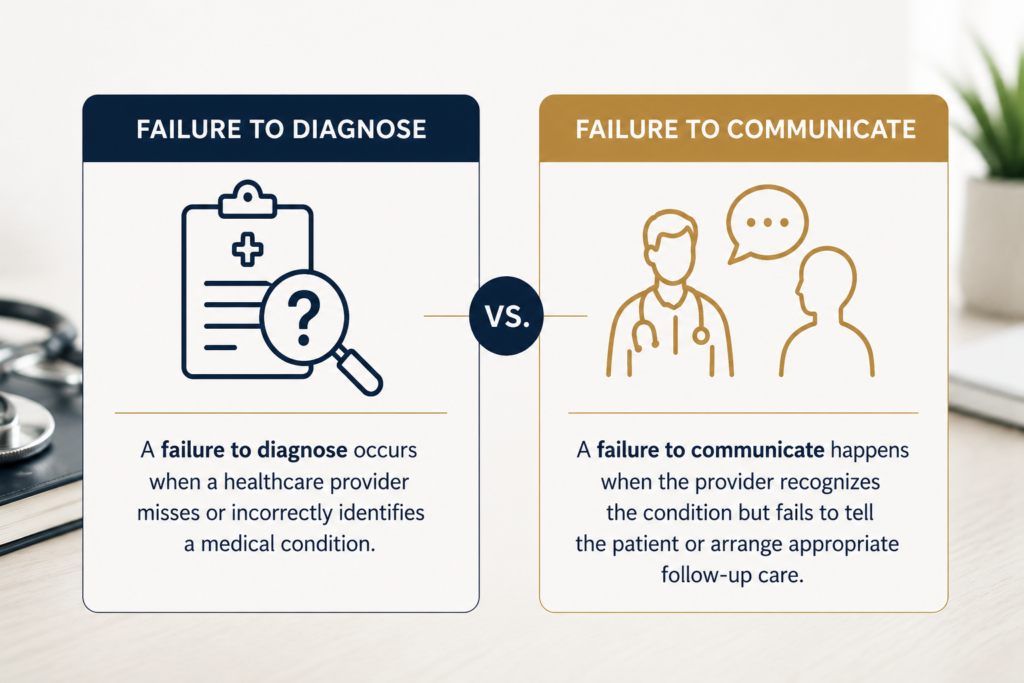
Both can lead to medical malpractice if the delay results in preventable harm, such as a worsening condition, more invasive treatment, or the loss of better treatment options.
What Must Be Proven in an Arizona Medical Malpractice Case?
To recover compensation, it is generally necessary to show more than the fact that your doctor failed to tell you something.
Under A.R.S. § 12-563, you must also establish that:
- The healthcare provider owed you a duty of care.
- The provider failed to meet the accepted medical standard.
- That failure caused your injuries.
- You suffered measurable damages because of the delay.
Under A.R.S. § 12-2603, medical malpractice cases almost always require qualified medical experts who can explain what should have happened and how earlier communication would likely have changed the outcome.
Why These Cases Can Be Technically Complex
Failure-to-communicate cases often involve thousands of pages of medical records, electronic chart entries, laboratory reports, imaging studies, and communication logs.
Determining exactly when the diagnosis was made, who received the information, and why the patient was never informed requires careful investigation.
When you trusted your doctor with your health, you deserved clear communication and competent care. Your legal team should command that same level of trust. That’s why Miller Kory Rowe medical malpractice attorneys brings together attorneys whose unique backgrounds strengthen every aspect of your case.
The firm’s collaborative approach also draws on the experience of Jeffrey Miller, a certified specialist in personal injury and wrongful death law whose practice includes professional negligence and complex medical malpractice claims. He has obtained significant jury verdicts in malpractice litigation and serves as an Assistant Professor of Practice at the University of Arizona College of Medicine, teaching future physicians about elder abuse and neglect.
What Compensation May Be Available?
If a healthcare provider’s failure to communicate caused additional harm, compensation may include:
- Past and future medical expenses.
- Lost income and reduced earning capacity.
- Pain and suffering.
- Permanent disability or disfigurement.
- Loss of enjoyment of life.
- Wrongful death damages for surviving family members, when applicable.
The value of every case depends on the specific injuries and the impact the delay had on your health.
Frequently Asked Questions
Is every missed diagnosis considered malpractice?
No. Some illnesses are difficult to detect even when doctors provide appropriate care. Medical malpractice depends on whether the healthcare provider failed to meet the accepted standard of care and whether that failure caused harm.
What if my test results were available in an online patient portal?
Every case is different. Simply uploading results to a patient portal may not always satisfy a provider’s duty to communicate serious findings, particularly if prompt treatment is necessary.
Can I sue if another doctor eventually found the condition?
Possibly. If an earlier doctor knew about the condition, failed to tell you, and that delay caused additional injury, you may have a medical malpractice claim.
How long do I have to file a medical malpractice lawsuit in Arizona?
Arizona generally gives you two years from when the cause of action accrues to bring a medical malpractice claim under A.R.S. § 12-542, though Arizona’s discovery rule can shift that start date depending on when you knew, or reasonably should have known, about the injury. It is wise to seek legal advice as soon as possible.
How much does it cost to speak with a medical malpractice attorney?
Miller Kory Rowe offers free consultations for injury cases, allowing you to understand your legal options before deciding how to move forward.
Take the First Step Toward Answers
Finding out that your doctor knew something serious and never told you can leave you with far more questions than answers.
If delayed communication changed your diagnosis, treatment options, or long-term health, you deserve to know what happened and whether it could have been prevented.
An experienced Arizona medical malpractice attorney can review your medical records, investigate the timeline, and help determine whether you have a claim. Even if you’re unsure whether negligence occurred, getting answers can help you make informed decisions about what comes next.