
Noticing something unusual from your last visit, a new bruise, sudden weight loss, a change in how they seem, is devastating.When you ask what happened, they can’t answer you, because you’ve watched your parent decline mentally over time, and some days she doesn’t even recognize you.
This is one of the hardest positions a family can be in, because the residents least able to speak up are the most vulnerable to abuse and neglect.
Arizona law still gives families tools to document concerns, request records, and trigger an investigation, even when your parent can’t describe what happened.
Speaking up doesn’t just protect your own family. It can be the reason a facility finally gets held to account before another resident gets hurt the same way, and our nursing home abuse attorneys are here if you need help pushing that process forward.
Why Nonverbal and Dementia Residents Are at Higher Risk
A nonverbal resident is someone who can’t communicate through speech, whether from a stroke, advanced Parkinson’s, ALS, or a condition like end-stage dementia.
A resident with dementia may still speak, but memory loss, confusion, or difficulty finding words can make it hard for them to describe what happened to them, or to be believed if they try.
Both groups share the same vulnerability: they can’t reliably report abuse themselves.
It’s a pattern that shows up clearly in Phoenix memory care facility abuse cases, where residents are frequently unable to recognize mistreatment, speak up for themselves, or recall critical details.
Arizona law defines a “vulnerable adult” as someone who can’t protect themselves from abuse, neglect, or exploitation because of a physical or mental impairment, under A.R.S. § 46-451.
A nonverbal or dementia resident falls squarely within that definition.
Various Ways to Report Nursing Home Abuse in Arizona
Where you report depends on what’s happening and how urgent it is. In an emergency, call 911 first.
Statewide
| Agency | Covers | Contact |
|---|---|---|
| Adult Protective Services (APS) | Abuse, neglect, and exploitation of vulnerable adults | 1-877-767-2385 (24/7) |
| Arizona Department of Health Services (ADHS) | Facility licensing, staffing, and quality-of-care violations | 602-364-2536 |
By County (Long-Term Care Ombudsman)
| County | Office | Contact |
|---|---|---|
| Maricopa (Phoenix) | Area Agency on Aging, Region One | 602-264-2255 |
| Pima (Tucson) | Pima Council on Aging | 520-790-7262 |
| Gila (Globe) | Pinal-Gila Council for Senior Citizens | 800-293-9393 |
Reporting to more than one of these isn’t redundant. APS investigates the abuse itself, ADHS investigates the facility’s compliance, and the Om
Who Can Legally File a Report on the Resident’s Behalf
You don’t need the resident’s permission or participation to report suspected abuse in Arizona. Several categories of people are not just allowed to report, they’re required to.
Mandatory reporters
Under A.R.S. § 46-454, health professionals, nursing home administrators and staff, social workers, clergy, peace officers, and anyone who has assumed responsibility for the care of a vulnerable adult (which covers most family caregivers) must report suspected abuse, neglect, or exploitation the moment they have a reasonable basis to suspect it.
Guardians and conservators
Have a distinct duty under the same statute. They must immediately report or cause a report to be made to the superior court, in addition to reporting to Adult Protective Services or law enforcement.
Family members and friends without formal authority
Adult children, grandchildren, friends, or neighbors who aren’t formal caregivers can still file a report. Arizona doesn’t require you to be next of kin, a power of attorney holder, or a guardian to call the hotline. This guide to reporting a nursing home to the state of Arizona breaks down each agency’s role for families who aren’t sure where to start.
Power of attorney holders and guardians
Have an added advantage: legal standing to request medical records directly from the facility. Under A.R.S. § 46-454, anyone with custody of a vulnerable adult’s medical or financial records must make those records available to a peace officer or APS worker investigating a report. Your own authority to request records comes from your appointment documents, not this statute, so keep a copy of that paperwork on hand when you request records or push back on a facility that’s slow-walking you.
No one currently holds legal authority
If the resident can no longer manage their own affairs and no one holds POA or guardianship, APS can petition for a guardian or conservator on the resident’s behalf, and a physician evaluation may be part of that process.
What Counts as Evidence When the Resident Can’t Describe It
You’re building a case out of physical signs, behavioral changes, and paper trails instead of a first-person account. All three matter, and they matter more together than alone.
Physical Signs to Document
- Unexplained bruises, especially patterns that suggest physical abuse
- Bedsores or pressure ulcers, which usually point to prolonged immobility
- Sudden weight loss or dehydration, often tied to feeding neglect
- Unexplained fractures or falls with no documented incident report
Behavioral Changes to Track
A resident with dementia can’t always explain fear, but their behavior often shows it. Watch for:
- Flinching or withdrawing when a specific staff member enters the room
- New agitation or aggression that wasn’t part of their baseline behavior
- Increased confusion or withdrawal beyond the disease’s normal progression
- Refusal to eat, bathe, or participate in activities they used to tolerate
Clinicians increasingly rely on standardized nonverbal pain and distress scales, like the Pain Assessment in Advanced Dementia (PAINAD) tool, specifically because patients with dementia often can’t self-report pain in words.
If the facility isn’t using a tool like this to track your loved one’s distress, that’s worth asking about directly.
Bottom Line
Reporting abuse on behalf of a resident who can’t speak for themselves comes down to documentation and persistence: track what you see, know who’s required to act on it, and use every reporting channel available to you.
Families working through this often bring in an attorney once a pattern emerges, not to replace the state investigation, but to request records the facility won’t hand over voluntarily and to evaluate whether the resident’s injuries point to a pattern of neglect rather than an isolated incident.
Miller Kory Rowe LLP nursing home abuse attornyes handle these cases specifically because the evidence gap created by a nonverbal resident is one of the most common obstacles families run into.
If you believe your loved one is in immediate danger, call 911 or local law enforcement first.
FAQs About Reporting Nursing Home Abuse
Q: Can I report nursing home abuse anonymously in Arizona?
A: Yes. Adult Protective Services allows anonymous reports, though providing contact information can help investigators follow up if they need more detail.
Q: What if the facility says my mother’s bruises are just from her dementia or unsteady walking?
A: Document the explanation the facility gives you, along with the date and who gave it, and compare it against what you’re observing over time. A pattern of bruises in the same location, or bruising inconsistent with a fall, is worth raising with APS or an attorney regardless of the facility’s explanation.
Q: Do I need power of attorney to request my parent’s medical records?
A: Generally, yes, unless you’re the appointed guardian or healthcare decision-maker, facilities aren’t required to release full medical records to family members who don’t hold that authority. If you don’t currently have POA or guardianship and the resident can no longer make decisions themselves, APS can petition for a guardian or conservator to be appointed.
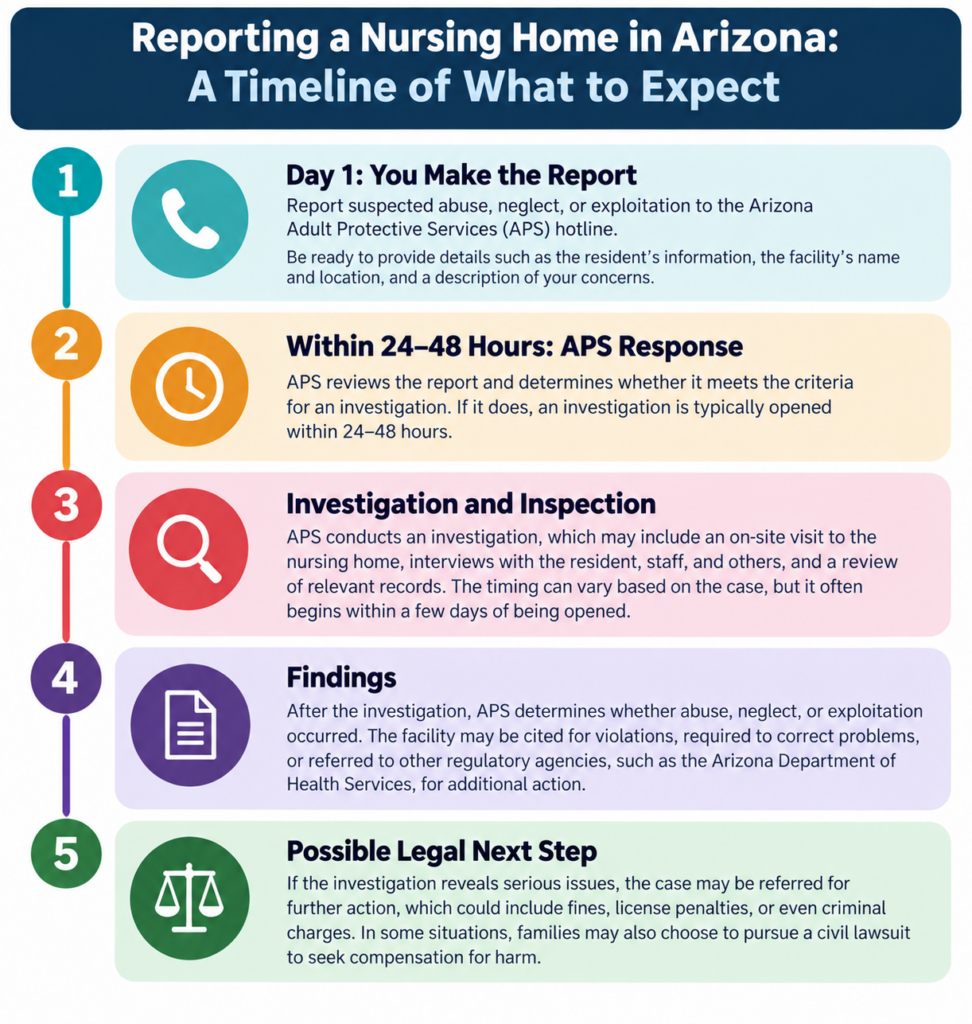
Q: What happens after I file a report with APS?
A: An APS investigator interviews the resident (to whatever extent possible), the alleged abuser, and any witnesses, reviews the facility’s records, and reaches a finding of substantiated, unsubstantiated, or inconclusive. Serious or urgent reports are typically prioritized for faster response.
Q: Can the nursing home retaliate against my loved one because I filed a report?
A: No. Arizona law protects good-faith reporters from retaliation, and any retaliation by the facility creates additional legal exposure for them.
Q: My loved one has good and bad days. What if she seemed fine when the ombudsman visited?
A: Note this in your log. Fluctuating presentation is common with dementia, and it’s useful context for investigators, not a reason to stop documenting.
Q: Should I call an attorney before or after reporting to APS?
You can do both at the same time. Reporting to APS starts the state investigation, and an attorney can help you request records, document the case, and evaluate whether a civil claim is appropriate, none of which requires waiting on the state’s findings first.